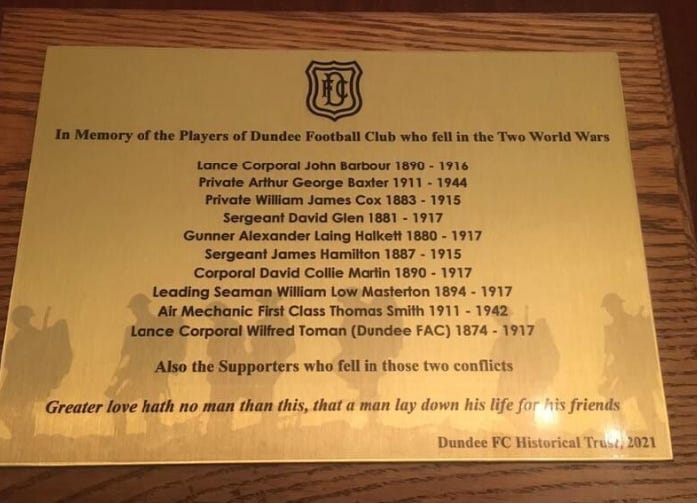
The Dark Blue Fallen
Dundee's Original European Heroes

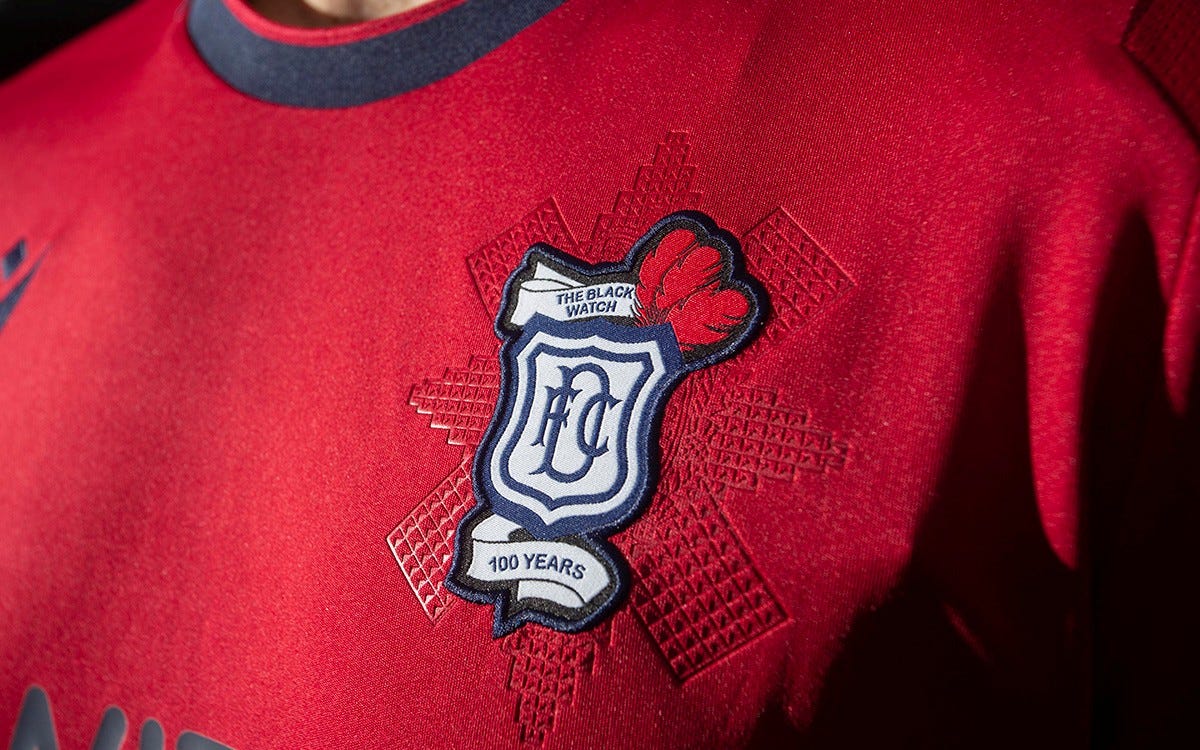
In the years before the First World War, Dundee Football Club were one of Scotland’s strongest sides.
The club had claimed its first major honour with the 1910 Scottish Cup and had twice finished runners-up in the league. Between February 1909 and April 1911, Dundee were unbeaten at home - Dens Park, where they had resided for a little over a decade after moving in 1899.
Dens was altered to accommodate crowds exceeding 30,000. Dundee looked to build on their success. Players were told to report for pre-season training on Tuesday, 28th July 1914, to prepare for the new campaign.
Little did they know, an entirely different campaign was about to begin. One not fought on grass, but in the trenches of Europe.
Seven days later, Britain declared war on Germany.
Football, like everything else, would never be the same.
Listed below are the former Dee players that perished while serving in the military during the First World War.
World War I
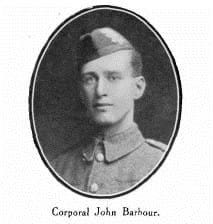
Lance Corporal John Barbour (1890–1916)
Signed from Queen’s Park, the inside-right played 17 matches for Dundee, scoring twice. Match reports describe him as skillful but inconsistent.
He later joined Preston North End, helping them to promotion before enlisting with the Highland Light Infantry.
Barbour was killed in High Wood, France, during the Battle of the Somme - a major British offensive in 1917, aged 25.
Private William James Cox (1883–1915)
The Liverpool-born striker scored 20 goals in 34 games for Dundee before joining Hearts, whom he scored a decisive brace against in his last game for the Dark Blues.
He served in the Gallipoli campaign, where he was critically wounded. Despite being transported to hospital in Birmingham, he died from his injuries in 1915, aged 35.
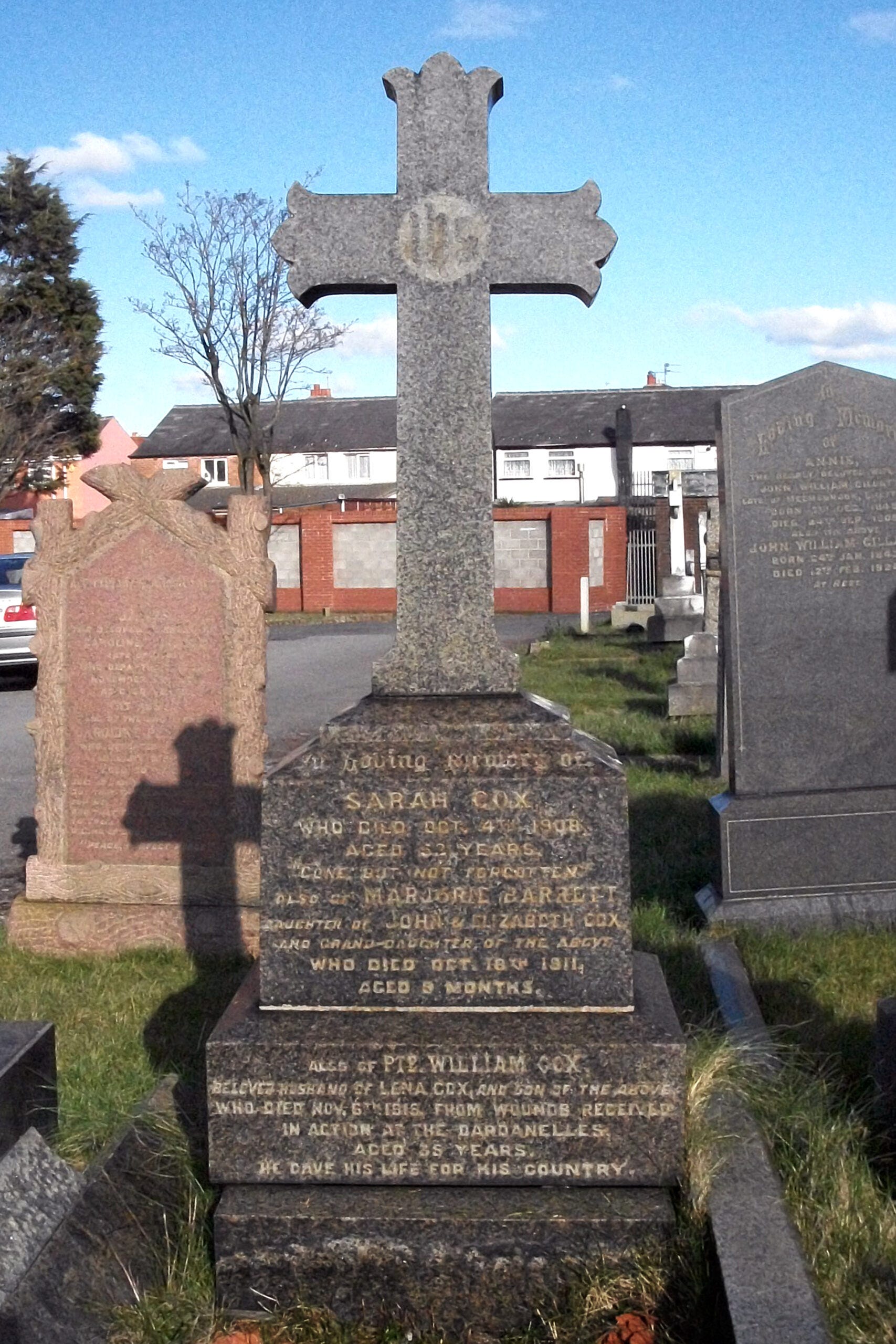
(William Cox’s grave in Blackpool)
Sergeant David Glen (1881–1917)
Glen’s time at Dens Park was brief — just a month in 1907 — but he was part of the side that finished as league runners-up to Celtic.
The Forfar born forward joined The Royal Scots (Lothian Regiment) and was killed near Arras, France, on April 9th, 1917, aged 36.
Gunner Alexander Laing Halkett (1880–1917)
A right-half who made 21 appearances between 1901 and 1904.
Halkett also featured for St Johnstone & Aberdeen before joining the Royal Artillery as a Gunner in the “C” Battery. 87th Brigade.
He was killed in action aged 37 in Pas-de-Calais, France, on February 21st, 1917.
Sergeant James Hamilton (1887–1915)
Little is known about Hamilton’s Dundee career, but his name endures among the club’s fallen.
He was killed in action, aged 28.
Corporal David Collie Martin (1890–1917)
The Brechin born forward scored his first goal for Dundee in a 4–0 win over then heavy-weights Queen’s Park in 1911.
Additionally he played for Dundee Hibernian (present day Dundee United) and his hometown team Brechin City.
He played his last match for Dundee in 1912, 5 years before he met his end with the Black Watch. Killed at Ypres Salient, Belgium, on March 26th, 1917, aged 27.
He is buried at the Railway Dugouts Burial Ground (Transport Farm) in the West-Vlaanderen region of Belgium.
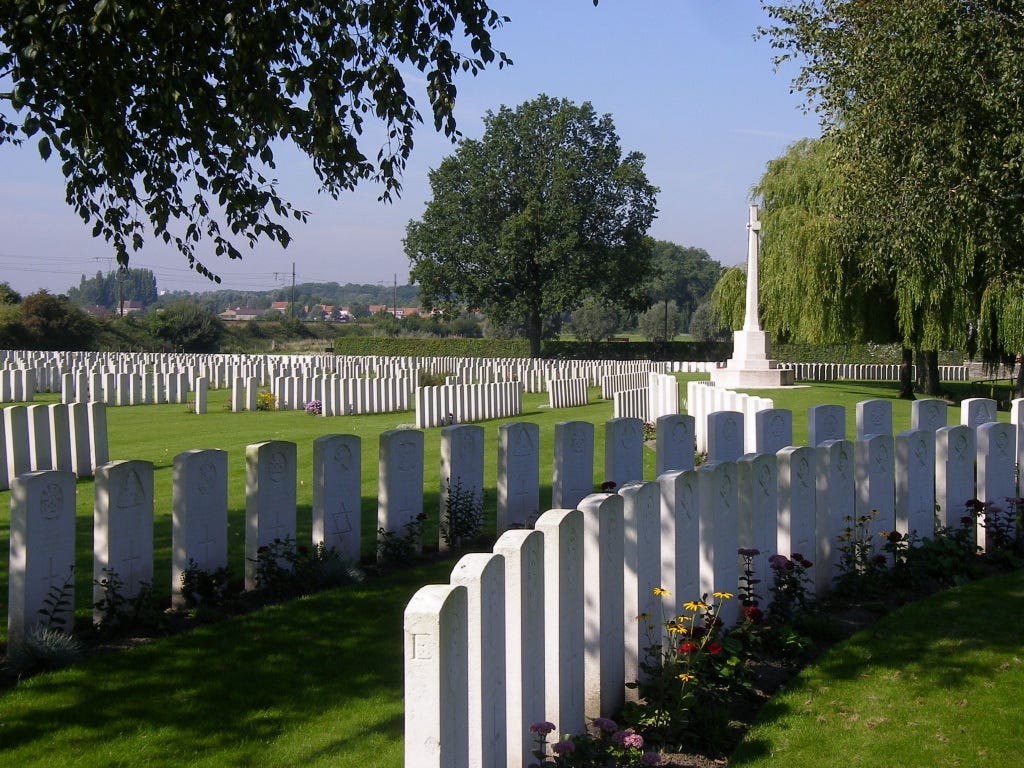
(Railway Dugouts Burial Ground)
Leading Seaman William Low Masterton (1894–1917)
A Dundonian goalkeeper with 24 appearances for Dundee, Masterton’s final game came in 1915.
He died two years later with the Royal Naval Volunteer Reserve in Villers-Plouich, France, aged 23.
His parents resided on Tannadice street when they received the telegraph informing them of their sons demise. His family’s grief mirrored thousands across the city - like the rest of Britain, had footballers in every regiment and loss in every street.
Lance Corporal Wilfred Toman (1874–1917)
Toman was a journeyman having played across Britain via Aberdeen, Burnley, Everton, Newcastle United, Southampton & Stockport County in addition to Dundee.
Information of his playing career is limited, we know he started for the Dee in a 3-1 defeat against Rangers in 1896.
He served with The King’s Regiment (Liverpool) before meeting his end, aged 43 on May 2nd, 1917, in the Armentières sector, France.
Prisoner of War
Danny Cameron
Predominantly played for the reserves but did make a handful of appearances for the first team. By December 1914 he had been captured by the Germans.
“I am a prisoner, but am keeping well and in good health. I will be released after the war, which I hope won’t be long. Give this to mother, as I have only one postcard.”
— The Courier, December 8th, 1914
World War II
The Dundee Football Club historical trust describes the 1920s and 1930s as a time of turmoil, they wrote:
It wasn’t until the appointment of George Anderson in 1944, near the wars end, that the club looked to turnover a new leaf and rise into a Golden Age. Titles, Silverware and molding the reputation of the club to a place they hadn’t been for the best part of thirty years. All of which came post-war.
In between all of that was the most devastating conflict in human history, costing Britain its Empire - losing an estimated 580,000-600,000 soldiers and civilians alike from the United Kingdom and its Commonwealth nations.
Amid the club’s struggles and the nation’s darkest hours, two more Dundee players would make the ultimate sacrifice - they are listed below.
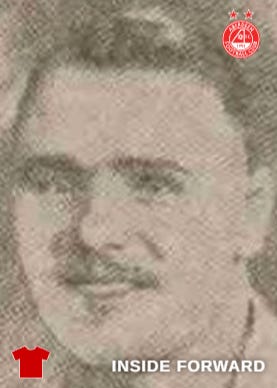
Private Arthur George Baxter (1911–1944)
A prolific forward with 45 goals in 101 appearances, the 5’9 Dundonian had an admirable record Infront of goal for his hometown team.
He scored the opener in Dundee’s 3–0 victory over Dundee United in the 1938 Forfarshire Cup Final — the club’s first derby win in three years.
Baxter also dawned the jersey’s of Falkirk, Aberdeen and Barnsley.
In 1943 he was the Captain of the London Scottish battalion team.
He fought with the Gordon Highlanders, a Scottish infantry division, when he died in action on September 5th, 1944, during the Battle of Rimini in Italy, aged 33.
Air Mechanic First Class Thomas Smith (1911–1942)
A dependable midfielder who played 191 matches for Dundee between 1931 and 1938, scoring seven goals.
He was killed in action in 1942 during the Second World War, aged 30.
Lest We Forget
They were footballers, sons, husbands, fathers, teammates, and heroes whose lives were cut short in service for the nation.
Their names live on in the fabric of Dundee FC’s history, and above that world history. These men were a small sample of a gargantuan sacrifice. Their stories serve as a reminder for the every day life we often take for granted.
The beautiful game stood still, and courage carried the colours of every team.
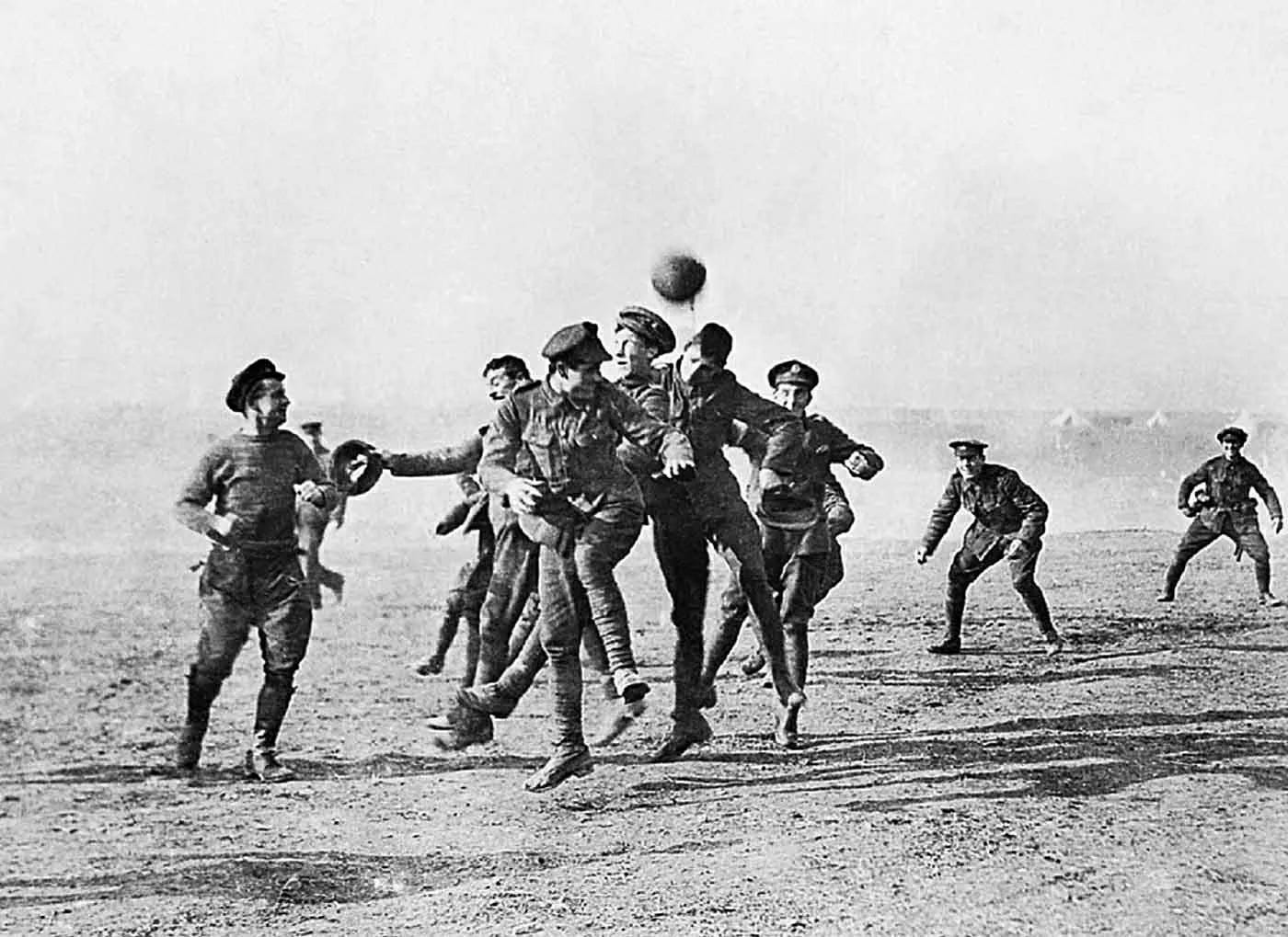
(British officers playing other ranks of the British 26th Divisional Ammunition Train. 1915, Greece.)
What’s Next?
My next piece dives into the legacy of George Anderson, the most influential manager in the club’s history.
Subscribe to be notified as soon as the next piece drops.
Every like, share, and subscription helps this platform grow. Thank you for supporting my work.
Finally, a personal tribute to all members of the armed forces in the format of a poem I had written several years ago - but never published anywhere until now.
Thank you for reading.
Remember Them
by Ethan Hampton

The earth shatters and splits around me,
When the shells crash,
I am forced to witness,
My brothers in a bloodbath.
When the bayonet strikes, I am forced to witness,
The life leaving their eyes.
I am forced to witness
Hell.
Remember that.
Remember me.

I’m losing my balance,
The surge of a fiery blast
Wipes out my friends within a single breath.
The smoke is blinding, and a blessing.
The flag has drowned,
Along with the screams.
My legs, submerged.
My lungs, filling with smoke.
It burns to breathe.
I am dread. I am
fear.
Was it all in vain?
Remember that.
Remember me.

Words can’t describe the pain.
My mind racing through so many pictures —
Mother, Father, Fireplace, Home.
Raindrops tapping against the window, canine kisses,
Before whistling bullets devoured the world.
I sketch other frames in my mind:
Things I haven’t done,
Things I’ll never have the chance to do.
My vision slowly fades away,
My soul lifts from my body,
Or what remains of it.
Everything, sacrificed
For an inch of bloodstained soil.
Silence becomes suffocating...
Remember that,
We die twice:
On the front, or years after —
And when our name is mentioned for the very last time,
Remember me.